Showing posts with label elections. Show all posts

Monday, November 3, 2008

How soon on election night will we know the winner

How soon on election night will we know the winner? When can we celebrate? Will it be mere minutes after the polls close in the East? Or are we going to have to brace for a late night like in recent elections?

On election night all those experts will have their fancy maps and go through scenario after scenario, plugging in the pieces of the puzzle as they trickle in. "ABC News calls New Hampshire for John McCain. This is what else McCain will have to win to get to 270..." blah blah blah.

I've made an election night cheat sheet to use yourself. When can the election be called?

The point is here not to predict when and how the media will call the election. Based on past experiences, they don't call states until the polls close there. So while we all know where California is going, the media won't put it blue on their nifty maps until after 11:00 PM EST. This is to help see when you yourself can feel confident to call the election ahead of the media.

First, we have a darn good idea how 34 states and the District of Columbia are going to go. Using Pollster's current weighed poll margins, I've preemptively put the states with 10 point or more margins with their candidate. (Notice the list doesn't include Virginia or even Arizona.) This is a hyper-conservative way to call the states.

OBAMA: 238 votes (ME, NH, VT, MA, RI, CT, NY, NJ, DE, MD, DC, MI, WI, MN, IL, IA, CA, OR, WA, HI)
MCCAIN: 123 votes (AK, ID, WY, UT, NE, KS, OK, TX, AR, LA, AL, TN, KY, SC, WV)

* - swing states

At 7:00 EST polls close in GA*, IN*, KY, SC, VT & VA*
  • If the media calls Virginia for Obama, he's at 251 with about 12 swing states left to call.
  • If the media calls Virginia and Georgia for Obama, he's at 266 with about 12 swing states left to call.
  • If the media calls Virginia and Indiana for Obama, he's at 262 with about 12 swing states left to call.
  • If the media calls Virginia, Georgia and Indiana for Obama, he wins with 277 already
  • If McCain surprises by somehow winning Virginia, get ready for a longer night. That only puts McCain up to 136, but it might be indicative of how Pennsylvania and Ohio will go.
At 7:30 EST polls close in OH*, NC* & WV (We'll see how well the vote counting and exit polls go in Ohio!)
  • If VA has been called for Obama, but not IN or GA, winning Ohio alone gets him to 271. He wins.
  • If VA has been called for Obama, but not IN or GA, winning North Carolina but not Ohio gets him to 266 with a number of states still in question.
  • If VA and IN have been called for Obama, winning either Ohio or North Carolina clinches it.
  • If VA and GA have been called for Obama, winning either Ohio or North Carolina clinches it.
  • If VA, GA and IN have been called for McCain, but Obama wins Ohio, he's at 258 with Florida, Missouri and a number of western states still in question.
  • If McCain has swept VA, GA and IN, and then Ohio and North Carolina, he's only at 174 to Obama's 238. But it would appear that the remaining states in question could just about all break his way.
At 8:00 EST polls close in AL, CT, DE, FL*, IL, ME, MD, MA, MS*, MO*, NH, NJ, OK, PA*, TN, DC (We'll see how the vote counting and exit polls go in Florida!)
  • If Obama is called to win Pennsylvania, he wins if any other previous or contemporary swing state is called for him (OH, NC, FL, MS, or MO). Otherwise, Obama is at 259 with PA alone. If McCain gets everything else called his way by this point, he'd have 241. (Obama would need to win CO and one more state, like NV or NM.)
  • If Obama is called to win Florida, he wins if any other previous or contemporary state in question is called for him (OH, NC, MS, MO, or PA). Otherwise, Obama is at 265 with FL alone. (If McCain gets everything else called his way by this point, Obama just needs NM or CO or NV to win.)
  • If Obama improbably wins Missouri, but not Pennsylvania or Florida, he's at 249 and we're going to have to wait for the western states.
  • If McCain sweeps Pennsylvania, Mississippi, Missouri and Florida, after sweeping all the earlier called swing states (OH and NC), he's at 262. (McCain would then only need to secure AZ or CO, or the combinations of SD-ND-MT, or NV with any other state or NM with any other state.)
At 8:30 EST polls close in AR

At 9:00 EST polls close in AZ*, CO*, KS, LA, MI, MN, NE, NM*, NY, RI, SD*, TX, WI, WY (If we don't know already, we'll likely know the winner once these states are called.)
  • If McCain has swept every swing state thus far, Arizona or Colorado or the New Mexico-South Dakota combination wins it for him.
  • If McCain has swept every swing state thus far, except PA, Colorado or Arizona plus either New Mexico or South Dakota wins it for Obama. CO is a must win for Obama if the election is still up in the air. In this situation, if McCain wins AZ, CO, NM, and SD, McCain would be one state shy of winning. If Obama takes CO and McCain takes AZ, NM and SD, Obama has 268 and would need just one more of the remaining 3 swing states.
  • If McCain has swept every swing state thus far, except OH, it's virtually the same situation as the previous scenario. (OH has 20 electoral votes and PA has 21.)
  • If McCain has swept every swing state thus far, except VA, how these four states break would make a big difference. Either candidate getting both Arizona and Colorado puts them within one state of winning (SD, NM, NV, MT, or ND). In the most likely scenario that Obama takes Colorado and McCain takes Arizona, whoever takes three of the remaining five states provided that one of the three is NV or NM, will win. (In the unlikely scenario of McCain taking NV and NM, and Obama taking ND, SD, MT, we'll have a 269-269 tie.)
  • If McCain has swept every swing state except VA and MO (or IN), Colorado or Arizona wins it for Obama If McCain gets Colorado and Arizona, Obama getting New Mexico puts him at 267, needing South Dakota to win, or to wait to snag ND, NV, or MT to win. If McCain gets Colorado, and Arizona, and New Mexico, and Obama gets South Dakota, Obama would be at 265 (to 262), needing to get NV or MT-ND to win. If McCain gets all four states (CO, AZ, NM, SD), he'd have 265 to Obama's 262. (McCain would win unless Obama got NV as well as either ND or MT.)
  • If McCain has swept every swing state thus far, except FL, Obama would be at 265 and only need Arizona, Colorado or New Mexico. Obama could lose all three and still win with South Dakota plus one more state (MT, ND, or NV). If McCain wins all four states, he'd still be trailing with 262 to Obama's 265 electoral votes. (Obama could win with NV or MT-ND.)
At 10:00 EST polls close in IA, MT*, NV* & UT
  • Montana and Nevada matter if McCain has swept just about every swing state and we're close to an electoral vote tie. In most scenarios (see in the previous state entries), Obama wins with Nevada or needs Nevada to win with Montana or the yet-to-close-their-polls North Dakota.
At 11:00 EST polls close in CA, HI, ID, ND*, OR, WA
  • Could North Dakota decide it? Maybe. If McCain swept every swing state except FL and MT (or SD), we'd be looking at Obama at 268 and McCain at 267. North Dakota's three electoral votes determine the winner.
  • If McCain sweeps every swing state except CO and PA (or OH), we have the same electoral vote set-up. This is not an entirely implausible situation.
At 1:00 EST polls close in AK

*****

Of course this exercise assumes some accuracy in the current understanding of the electoral map. If either candidate wins a state seen as solid for the other, all bets are off. Most likely that means a landslide either way. If McCain wins Michigan, he's probably going to win the election handedly. If Obama wins Tennessee, he's probably going to win the election handedly.

The assumption also is that states will be called by the media in the order they finish voting. We can guess that contentious swing states might take some time before they're called. Some states like Ohio and Florida might have some trouble counting their votes in a timely manner.

My suggestion for election night would be to go over to 270towin.com with their interactive map. Color all states that are solid McCain or Obama ahead of time, and then complete the swing states as they are called throughout election night. You don't need to listen to the "experts" with their fancy graphics--you can do it yourself.

Won't get fooled?

In an effort to keep my electoral optimism in check, I present "Won't Get Fooled Again" from The Who.


I'm not really as cynical as this song. But it does underscore how difficult true change is.

Lyrics to Won't Get Fooled Again

We'll be fighting in the streets
With our children at our feet
And the morals that they worship will be gone
And the men who spurred us on
Sit in judgement of all wrong
They decide and the shotgun sings the song

I'll tip my hat to the new constitution
Take a bow for the new revolution
Smile and grin at the change all around me
Pick up my guitar and play
Just like yesterday
Then I'll get on my knees and pray
We don't get fooled again

The change, it had to come
We knew it all along
We were liberated from the foe, that's all
And the world looks just the same
And history ain't changed
'Cause the banners, they all flown in the next war

I'll tip my hat to the new constitution
Take a bow for the new revolution
Smile and grin at the change all around me
Pick up my guitar and play
Just like yesterday
Then I'll get on my knees and pray
We don't get fooled again
No, no!

I'll move myself and my family aside
If we happen to be left half alive
I'll get all my papers and smile at the sky
For I know that the hypnotized never lie

Do ya?

YAAAAAAAAAAAAAAAAAH!

There's nothing in the street
Looks any different to me
And the slogans are replaced, by-the-bye
And the parting on the left
Is now the parting on the right
And the beards have all grown longer overnight

I'll tip my hat to the new constitution
Take a bow for the new revolution
Smile and grin at the change all around me
Pick up my guitar and play
Just like yesterday
Then I'll get on my knees and pray
We don't get fooled again
Don't get fooled again
No, no!

YAAAAAAAAAAAAAAAAAAAAAAAAAAAAAAAAH!

Meet the new boss
Same as the old boss

Wednesday, October 29, 2008

Turtle's Voting Guide: The whole darn ballot

Recently Slate magazine published how their staff were planning on voting in the presidential election under some notion of providing transparency. I know people are clambering, clambering I say, to know how I'm going to vote.

Well, maybe I haven't decided yet? Did you ever consider that?

I'll at least leave you with my thoughts the choices from the top of the ticket to the local questions on my own ballot. This is ballot for Minneapolis Ward 9, Precinct 1 in Minnesota. Incumbents have a *. You can make your own assumptions on how I will vote.

PRESIDENT
  • Chuck Baldwin, Cons - The Constitution Party are kind of like libertarians, except that they are hell-bent to ban abortion and aren't so thrilled with the separation between church and state.
  • Bob Barr, Lib - Got to hand it to Bob Barr. He's his own person.
  • Roger Calero, SWP - I checked out his campaign website, which is hosted by the socialist newspaper he edits, The Militant, which might be a violation of federal campaign and tax law.
  • John McCain, R-While I wouldn't have voted for McCain in 2000, I had respect for him. I no longer hold any respect for him.
  • Cynthia McKinney, Grn - I generally don't vote for people who assault police officers. Conspiracy theorists turn me off too.
  • Ralph Nader, Indep - Nader probably has the biggest ego in this race; and keep in mind that he's competing for that title with Obama, McCain, Barr, AND McKinney.
  • Barack Obama, D - He's a centrist. He's less liberal than John Kerry. But he's a pragmatic and principled centrist. He actually has some plans to deal with our most pressing problems. Plus, I'm more confident that he'll try a couple things first before starting a war.

U.S. SENATE
  • Charles Aldrich, Lib - I once tabled at the Minnesota Libertarian Party convention. It was creepy.
  • Dean Barkley, I - Barkley is a principled centrist. He has mostly well thought-out policy positions and a couple of screwy ones that will go nowhere so who cares. A reasonable choice.
  • Norm Coleman, R* - Coleman is hands-down the most slimy politician in Minnesota, possibly the Midwest. Seriously, he is a do-and-say-anything-to-get-elected guy. Coleman spent 4 years kissing Bush's ass and the last two running away from him. On the eve of the 2006 election all of a sudden he thought that there were problems with the Republican agenda in Washington and the way the war in Iraq was going. Norm must go.
  • Al Franken, D - I liked Al Franken a lot in his previous careers. His play-it-safe, tone-deaf campaign has been underwhelming. But he understands public policy and would vote mostly the right way (party line).
  • James Niemackl, Cons - According to the Star Tribune, he is a "member of the Knights of Columbus and Fraternal Order of Police." Enough said.

MINNESOTA SUPREME COURT AND APPEALS COURT
SUPREME COURT ASSOCIATE JUSTICE
Seat 3
  • Paul H. Anderson * - A respected incumbent associate justice. He was "found qualified" by the Minnesota Women Lawyers.
  • Tim Tingelstad - Has fought to politicize judicial races. Told the Star Tribune: "I believe that justice is served when judges fear God and love the people." Unsurprisingly the religious right wants him elected really bad. He was not found qualified by the Minnesota Women Lawyers.

Seat 4
  • Lorie Skjerven Gidea * - Gidea is a recent appointee and seen as a Tim Pawlenty lackey with little prior judicial experience. Although the Minnesota Women Lawyers found her to be qualified.
  • Deborah Hedlund - Hedlund has also been found qualified by the Minnesota Women Lawyers. I hear that she's kind of crazy in the courtroom. Her campaign YouTube videos are uninspiring.


APPEALS COURT JUDGE
Seat 1
  • Edward Toussaint *- Only one in the race!
Seat 8
  • Thomas J. Kalitowski *- Only one in the race!
Seat 9
  • Roger M. Klaphake *- Only one in the race!
Seat 10
  • Harriet Lansing *- Only one in the race!
Seat 15
  • Kevin G. Ross *- Only one in the race!
Seat 16
  • Dan Griffith - Griffith is running on a platform that judges should be elected, not appointed. He was not found qualified by the Minnesota Women Lawyers.
  • Terri J. Stoneburner * - The incumbent has been endorsed by the Academy of Certified Trial Lawyers and found qualified by the Minnesota Women Lawyers.

SALES TAX AMENDMENT
  • Constitutional amendment: Increase state sales tax by 0.375% to pay for environmental and cultural programs.
Details: "Tax increase amounts to 38 cents on a $100 purchase. Money would be divided among projects related to clean drinking water (33%), natural areas and wildlife habitat (33%), parks and trails (14.25%) and arts and culture (19.75%). Must be approved by a majority of all voters - not voting on the question counts as a "no" vote."
Think of it this way: When you go to Target and buy some diapers, some baby wipes, a cheap plastic toy, vitamins and Advil, oh and then a birthday present for your daughter's friend's six year old birthday party, you might find yourself astonished it all added up to a $100!. Money is tight these days. But if you're spending $100 at Target, you can afford to chip in 38 cents that --with everyone else's contribution--will do tremendous things to clean our waterways, have state parks that are open on Memorial Day weekend, and maybe stop our community theaters from closing. The Legislature and Governor haven't been able to agree to fund our long-term priorities for a couple of decades, so it's up to the voters.

U.S. HOUSE
District 5
  • Barb Davis White, R
  • Keith Ellison, D*-Remember two years ago the contention in the congressional race here? People were freaking out that a "radical," black Muslim would go to Congress. The world didn't fall apart and all those local DFLers spitting venom two years ago are now oddly quiet.
  • Bill McGaughey, I

MINNESOTA HOUSE
District 62A
  • Jim Davnie, D*-Davnie has spent his time in St. Paul working for education reform and funding, addressing the foreclosure crisis, and defending personal equality, among many other things.
  • Dave Shegstad, R-The local crank on Minnehaha Avenue. Shegstads the one who three years before anyone heard of Sarah Palin told us in his write-in City Council run that the "real people" supported him even though evidently the real voters didn't.

4TH DISTRICT COURT
Seat 9
  • Philip D. Bush * - Endorsed by Republicans, Democrats, and even a union.
  • Eugene Link - I can't find anything on the web about the guy. Honestly, why waste voters' time running if you can't put up a simple website or answer the Star Tribune questionnaire?
Seat 53
  • David L. Piper - Piper has gotten the endorsements of numerous prominent Democrats and Republicans, as well as local law enforcement and judicial officials. He was found qualified by the Minnesota Women Lawyers. Umm, and e has a very lawyerly name.
  • Jane Ranum - Ranum has gotten the endorsements of numerous prominent Democrats and Republicans, as well as local law enforcement and judicial officials. She was found qualified by the Minnesota Women Lawyers. Ranum is a former excellent state senator. It'd be nice to have some more qualified women in the judiciary.
Seat 58
  • Thomas F. Haeg - Haeg has gotten the endorsements of numerous prominent Democrats and Republicans, but mostly the wrong ones. He was found qualified by the Minnesota Women Lawyers.
  • James T. Swenson * - Swenson has gotten the endorsements of numerous prominent Democrats and Republicans, but mostly the wrong ones. He was found qualified by the Minnesota Women Lawyers. Perhaps go with the incumbent, even though he's endorsed by Rich Stanek?

HENNEPIN COUNTY SOIL AND WATER SUPERVISOR
Seat 1
  • Kim N. Boyce * - Only choice. Yay!
Seat 3
  • Richard A. Klatte - His most important issue is: "Global Warming. Making big oil companies pay for cleaning the air, water, and soil they've destroyed." Good luck taking down Big Oil on the Hennepin County Soil and Water Board!
  • Ben Torell - "Balancing the Preservation of our Natural Resources while endorsing responsible enjoyment of the outdoors." He's an ATV enthusiast.
  • James Wisker - Has a "Bachelor of Science in Ecology, Evolution and Behavior and am currently employed as the Program Manager for the Regulatory Department at Minnehaha Creek Watershed District." Hey, maybe we want someone actually qualified for this position!
  • Rahn V. Workcuff - "I strongly agree that a marriage should be only between a man and a woman. I am not in favor of same sex marriages. I strongly agree that all MN residence should have affordable health insurance. even if it means new or added cost to businesses. I strongly agree that we dont (sic) need anymore increase in taxes, we are all ready being taxed to death." He's more ambitious than the Klatte taking on Big Oil!
Seat 5
  • Jeffrey A. Beck - Says good things about utilizing ecological principles, but can't write in complete sentences or use punctuation in his position statement.
  • Karl Hanson - Wants to protect private property rights. I'm torn.

MINNEAPOLIS SCHOOL DISTRICT
  • Operating levy: $585 per pupil increase
"$172 tax increase on a $213,000 house. Total per pupil levy if passed: $1,200. To hire more teachers, keep class sizes down, purchase technology and textbooks and improve reading, math and science programs."
The state and federal governments aren't doing their job funding education, so this is the way we have to do it. Improving the schools has a direct impact on housing values, so it's in everyone's best interest to approve the levy.


  • Referendum: Expand school board and elect some members by district
"Minneapolis voters will decide whether to expand the city's school board from seven to nine seats with three elected citywide and six elected by districts, similar to the city's Park and Recreation Board. All are now elected citywide. If approved, the plan would be phased in over two voting cycles."
This measure is thanks to legislation forwarded by Rep. Jim Davnie and supported by the entire Minneapolis legislative delegation. The School Board had an opportunity to put it into effect and move forward, but instead the incumbents chose to fight it by putting it on the ballot and delaying implementation two more years. The current school board, while greatly improved from 4 years ago, is not accountable. Voters don't know who to hold accountable for our failing schools right now. When I wrote each member of the school board about this proposal, only two even responded back to me. That solidified my belief that the current structure doesn't encourage accountability when you have 7 at-large representatives from the entire city.


School Board Member - 3 seats
Vote for 3
  • Carla Bates - Endorsed by the DFL and SEIU. What else do you need?
  • Jill Davis - Endorsed by the DFL, the AFL-CIO, SEIU and the teacher's union. What else do you need?
  • Sharon Henry-Blythe * -Has been an incumbent too long and part of the problem.
  • Lydia Lee * - Lee is running for her second term and has done a good job. A quality board member despite her opposition to the school board reform plan. Endorsed by the DFL, SEIU and the teacher's union. What else do you need?
  • Doug Mann - Local crank that got kicked out of the local NAACP for being disruptive. At least he has a website.
  • Kari Reed - She homeschools her five children. She opposes the current levy proposal because the schools evidently don't need more money, but "creative solutions" like homeschooling and charter schools. I think we know where her priorities lie. She'd be a nightmare on the Board.

Saturday, October 25, 2008

October 25, 2002

October 25 is the anniversary of the death of Senate Paul Wellstone. Wellstone, his wife and daughter, supporters, and two pilots died in a plane crash in northern Minnesota ten days before the 2002 election day.

I was working for an advocacy organization working to get the pro-choice vote out in order to get Paul Wellstone reelected. The loss of a great advocate and the loss of the election were double blows that crushed the spirit of the progressive community in Minnesota. It is still recovering.

I had met Paul Wellstone on a couple of occasions. I had lobbied him to do more on the crushing Iraq sanctions. I met his daughter, Marcia, a couple weeks earlier when she came to a rally we held to underscore the importance of the Senate race for the balance of the Supreme Court.

On the day of the plane crash, I was to join a bunch of activists to ride on the campaign green bus from St. Paul to Duluth, to watch the U.S. Senate debate that evening. Before leaving the office, we heard that the campaign's plane was missing. We stopped and waited. A little while later, Minnesota Public Radio confirmed that the plane had crashed and everyone aboard had died.

We didn't just lose a Senate seat. We didn't just lose a great Senator. We lost one of the great leaders of the progressive movement. Wellstone had been in the Senate for two terms, but was just starting to find ways (and seniority) to make a difference. He was much further to the left than most voters in Minnesota, but people respected him tremendously. This short, feisty, screaming, Jewish, college professor originally from North Carolina stood out like a sore thumb in Minnesota, a state that is reflected more accurately by Garrison Keillor than the reserved natives would care to admit.

Wellstone's vote against the Iraq war resolution shortly before his death was the bravest act of his political career. George Bush started 2002 with a 85% approval rating. Those were the days that just about everyone in the political and media establishment agreed that Iraq constituted a grave threat. Bill Clinton was for it. Al Franken was for it. Even Dan Savage was for it.

Not Paul Wellstone. His vote was seen as political suicide by Beltway pundits. Of course they were wrong. His standing in the polls were not hurt by his vote. Minnesotans respected his convictions deeply, even though many of them disagreed with his vote on the most pressing issue of the day.

So many stories abound about how Paul Wellstone touched individuals. I remember talking to the cashier at the grocery store. She told me about working at the airport and seeing Paul Wellstone on his frequent trips between DC and the Twin Cities--usually outside baggage claim where she was taking a cigarette break. He would always say hi to her and gently chastise her for smoking. One day, he stepped it up and flat out told her she needed to quit. A few weeks later, she quit smoking and gave him the credit for making her do it.

Today Salon's Thomas Shaller wrote: "If Al Franken holds on to beat Norm Coleman to retake the seat Wellstone once held, Franken has some rather big shoes to fill."

But for better or for worse, in the minds of progressives in Minnesota, no person will ever be truly worthy of Paul Wellstone's seat. While I may very well vote for Al Franken, I know he is no Paul Wellstone. While Paul Wellstone convinced airport workers to quit smoking, Al Franken is known for not tipping airport cabbies. While Paul Wellstone lived his convictions regardless of the potential political consequences, Al Franken is running a centrist, DLC, play-it-safe campaign. So in my mind, Al Franken could never be anything like Paul Wellstone, neither could any other living person.

Certainly, Franken or the third party candidate Dean Barkley, would make immeasurable improvements and no longer constitute the stain on Wellstone's seat that is Norm Coleman. Coleman was elected in a wave of anti-Democratic sentiment after Republicans milked the "controversy" of Wellstone's "funeral-slash-rally" for all that it was worth. In a show of how classy he is, Coleman told the Roll Call newspaper six months after Wellstone's death that "To be very blunt and God watch over Paul's soul, I am a 99 percent improvement over Paul Wellstone. Just about on every issue."

If you talk to a progressive from Minnesota about October 25, 2002, you will hear how those deep wounds persist to this day. While Barack Obama is no Paul Wellstone, an Obama victory and the punting of Norm Coleman from Wellstone's seat would be two ever-sweet victories. It would make us feel that we were living up to Wellstone's legacy at least in part.

Tuesday, October 21, 2008

Aren't I smart?

Last August, before John McCain picked Sarah Palin, and right before we learned Barack Obama picked Joe Biden, I made a back-of-the-envelope electoral college prediction.  In the following weeks I've watched states change back and forth at pollster.com and felt mighty stupid--especially with my prediction that Montana would go to Obama.  But now let's compare my prediction two months ago with pollster.com's map two weeks out:


If all the states that Pollster.com rates as toss-up break to McCain as he throws the last minute Ayers and Wright dirt at Obama, except for the enlightened people of Montanta, I'll have predicted each state's vote perfectly. If the good people of Omaha, Nebraska and suburbs vote for Obama, that additional electoral vote will match with my crazy prediction of Obama winning with 290.

Sure, sure, a lot can change in the next two weeks and we don't know how the toss-up states will break. I'm just saying I don't look as crazy as I thought I looked myself a short time ago.

Post script: Let me be clear, in any case I'd much prefer a wider margin Obama win. My ego could take being drastically wrong.

Tuesday, October 7, 2008

Tiebreaker? Obama tries to snag Omaha

For most of us regardless of political persuasion, I present a nightmare scenario:

<p><strong>><a href='http://projects.washingtonpost.com/2008/pick-your-president/'>2008 Election Contest: Pick Your President</a></strong> - Predict the winner of the 2008 presidential election and enter to win a $500 prize.</p>

An electoral college tie, in which case (as long as there are no faithless electors) the House of Representatives will decide who fills the White House in 2009. We have not seen this situation since the Adams-Jefferson contest in 1800.

Yeah, yeah, I know this is unlikely. If you believe Pollster and other sources, Obama will comfortably win next month. But a tie is within the realm of the possible.

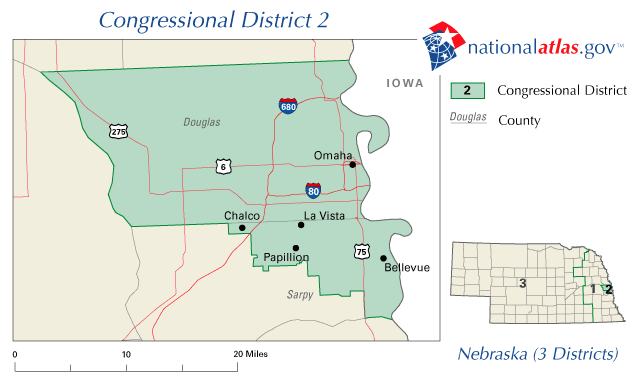
Let's suppose McCain and Obama win the states as shown above. You could have a situation where an electoral vote is pealed off in Maine or Nebraska, the two states that don't award all their electoral votes carte blanch. The Obama campaign has evidently put some resources in Omaha, home of the second congressional district. If Obama won the majority of the vote in Nebraska's 2nd, he'd get one more electoral vote and win 270 to McCain's 268. Nebraska awards 2 of its electoral votes to the statewide winner and 1 each for the winner of its 3 congressional districts.

Is that at all likely to happen? Short answer: Maybe. Omaha is more Democratic than the rest of the state, but this is still Nebraska after all.

In both 2004 and 2000, Douglas County (which contains 4 out of 5 voters in the district) voted for Bush by 18% and 16% respectively. Of course, compare that to the state as a whole, which voted for Bush by 30% and 34% margins respectively. The other part of the 2nd, with 20% of the voters, is a slice of Sarpy County. This part of the 2nd is more Republican and closely mirrors the rest of the state's voting.

For their part, the Obama campaign is being clear they're making an effort. They've opened an office in Omaha. Just today, the campaign snagged the endorsement of Lilibet Hagel, wife of the very popular and renegade Republican Senator Chuck Hagel of Nebraska. (Sen. Hagel, a former friend of McCain, has declined to endorse anyone.)

The Republicans aren't taking this lying down. Recently, Gov. Palin herself did a campaign stop in Omaha.

Can the Obama campaign pick up a third of the districts voters who supported George W. Bush and win the district?

No public polling has looked at the district, but a handful of statewide polls have come out. McCain is unsurprisingly in a comfortable lead by a 19% margin in the most recent poll. Using the statewide result as a starting point and assuming that the 2nd district will vote a fixed amount more Democratic, we can estimate some possible scenarios.

SCENARIO 1: Current Pollster statewide margin for McCain +22.3
This scenario assumes that the strong Obama organizing machine will increase turnout a bit more in the almost Democratic Douglas County than Repbulican stronghold of Sarpy (10% versus 7.5%). It assumes that Sarpy votes the same way as the state and Douglas votes with a margin of 15% towards the Dems (a change of 7.5% for each candidate). Using Pollster's most recent calculation McCain wins the state and the 2nd district comfortably (in red).

SCENARIO 2: Obama's best showing in the polls (way back in February!); statewide margin for McCain +3.0
Same assumptions as the first scenario. In this unlikely electoral shocker, McCain squeaks out a win statewide, but Obama grabs a hold of the 2nd by a 9 point margin. If this is the way it turns out on election day, we wouldn't be facing an electoral tie, but an unprecedented nationwide landslide. If Obama could get within 3 points of McCain in Nebraska, he's winning a lot more states overall.

SCENARIO 3: Election decided by less than one vote per 2nd district precinct; statewide margin for McCain +12.2
Could we have a national election won by a thinner margin than the several hundred (that were counted) in Florida in 2000? Here we have a situation where Obama takes the White House thanks to 122 voters that decided to turn out and vote for him in Omaha, Nebraska. Unlikely, sure, but possible. Only in America...

*****

Now, of course, the campaigns have much more sophisticated tools for analysis than this. The Obama campaign is probably counting on a bigger turnout of their voters, though one shouldn't automatically assume that the Republican voters won't turn out in force.

What we have is a rough sketch of at what point Omaha becomes truly in play. Current polling suggests that it is still out of reach for Obama, but not necessarily a fools errand. If statewide polling for Nebraska shows it to be a 10-15% margin instead of the more recent 20% plus margin, pay attention, and start figuring out if you know anyone in Omaha who needs a voter pep talk before next month.

Wednesday, September 3, 2008

McCain's Plan B

As the New York Times told us yesterday, it has become increasingly apparent that the selection of Sarah Palin was a last-minute rush job. Not that any of us needed to be told that.

“They didn’t seriously consider her until four or five days from the time she was picked, before she was asked, maybe the Thursday or Friday before,” said a Republican close to the campaign. “This was really kind of rushed at the end, because John didn’t get what he wanted. He wanted to do Joe or Ridge.”

I had thought all the talk of Joe Lieberman and Tom Ridge were intentional diversions from the McCain camp with the purpose of keeping the media in the dark of the true running mate pick and signaling to moderates that McCain is such a maverick that he at least considered a "pro-choice" "Democrat." Evidently I was wrong. McCain really was hell bent on selecting Lieberman until the right wing honchos set him straight in the preceding week or two.

Responding to the media drawing the obvious conclusions that they didn't fully vet Palin, the McCain camp said, oh no no no, she got a full FBI check. Never mind that a campaign using the FBI to investigate a candidate would be illegal and the FBI denies it. But wait, they point out, she got a questionnaire that other candidates received that had 70 whole questions. If you ask if they followed up to verify any of Palin's responses you'll find that the McCain campaign people have quickly scuttled away.

What does this say about McCain besides that he may have poor judgment when it comes to picking quality people? For me it makes it clear that the campaign had absolutely no Plan B in place for the very real possibility that Lieberman and Ridge would not work out. If they thought that Romney and Pawlenty were too "conventional," certainly they could have had a couple more quality people in the wings they could have spent time vetting? But no! They were stuck and had to scramble to get their shit together at the last minute.

Haven't we learned the negative consequences of having a guy in the White House who doesn't see the value in planning any contingencies? Haven't we learned there is nothing noble about moving forward with plans without modification despite mounting evidence that it's not going to work? Haven't we learned, now marking the anniversary of Hurricane Katrina, that you got to make sure people are up for the job before you give it to them?

John McCain, with 72 years of life experience and having lived through nearly 8 years of the Bush administration, hasn't learned these lessons. Will voters be able to do a better job and not repeat the mistakes of the past?

Friday, August 22, 2008

Electoral College Predictions

I love making political predictions. Sometimes I've got to pat myself on the back for my astute observations and ability to prognosticate the future. One of my best predictions was to say that Howard Dean was going to become a real force in the 2004 primary a full year before Iowa. One of my worse predictions was to say one week before the election that Tim Pawlenty would come in third in the open race for governor in Minnesota in 2002. (He won.)

Right now the polls are saying so many different things about the presidential election. I for one don't think much stock should be put in the polls until mid-September. Obviously, a lot of voters are waiting things out before firmly making up their minds. Still, it's fun to guess where things are going.

Obama clearly has the advantage this year. He's a better candidate than McCain. It is a toxic environment for Republicans this year. Obama has a huge money advantage. But that isn't to say it is going to be a blow-out or that even Obama has a lock on it. I've been saying for the past nine months that the race is going to be tight and we'd really have no idea who won until late on election night.

That being said, here's my stab 2 1/2 months out on what it will look like. If I'm right, the Washington Post will give me a $500 Best Buy certificate. I do think that Missouri, Ohio, and Florida will be close, but that McCain will edge out Obama. Obama wins by holding on to the upper Midwest and picking off some key Western states.

<p><strong>><a href="http://projects.washingtonpost.com/2008/pick-your-president/">2008 Election Contest: Pick Your President</a></strong> - Predict the winner of the 2008 presidential election and enter to win a $500 prize.</p>

Tuesday, August 12, 2008

Shady politics: Al Franken

Norm Coleman and the Republicans have been blasting Al Franken with negative ads.

Al Franken hasn't been shy about returning the fire. His latest ad:


The first part is a response to this Coleman ad attacking Franken for his tax and accounting troubles. Franken is smart to respond to these charges and not ignoring them. Ethical concerns are taken very seriously by voters. Is this an effective response? If the best you can say is, "It was an honest mistake," you're making a pretty weak case. Fair or not, phrases voters generally don't like to hear from politicians include, "it was an honest mistake."

Moving from defense mode to attack mode within the same ad is probably a good strategic move, especially when it is also on the issue of ethics. Senator Coleman lives in a mansion in DC practically given to him for a mere $600/month by his lobbyist-related friend? That sounds pretty bad.

At best, though, Franken is playing loose with the facts. While there are legitimate ethics issues with Coleman's rental arrangement that was first revealed by the National Journal in June, it isn't to the scale Franken describes. Coleman is living in a small basement studio apartment for $600. It's been a few years since I lived on Capitol Hill, but I remember lots of what are referred to as "English Basements" in the row houses on Capitol Hill. Usually they went for at least $900/month then. But living in a $600 basement apartment is a bit different from an entire "mansion."

I'm no fan of Norm Coleman. He's a slimy, unprincipled, political opportunist without a single ounce of integrity. Alas, Al Franken appears to be stooping to his level.

In fairness, here's another of Coleman's prominent nasty ads that's been covering the Minnesota airwaves for the last two weeks.

John McCain: One term pledge?

Over the past week rumors have resurfaced on whether John McCain is secretly planning or will publicly acknowledge a one term commitment. Operating under the assumption that the rumors are from the McCain campaign the logical question is whether this is for real or another attempt to grab attention like when they played Robert Novak for a fool regarding an imminent running mate announcement. I suspect this is for real and not a cynical ploy, because this is a dicey issue with which the McCain campaign will not want to screw around.

Earlier this year when news arose that the McCain considered the idea of a one term pledge, his campaign quickly moved to deny and downplay it as never a serious discussion. McCain himself is quoted as dismissing the idea "because I think then you’re the lame duck, you’re quacking on Inauguration Day."

Making a one term promise or even implying it is under consideration would be a bold move that would have an impact on voters' decision making. The McCain people wouldn't want these rumors to float out there unless they were really committed to it because it would lead to questions on McCain's own views on his fitness for the office and whether he was being honest with the American people. McCain's campaign manager Rick Davis responded to the question this last week with a "you're going to have to come to the Republican convention" and declined to discuss the matter further.

The thinking behind a one term pledge for McCain is that it would minimize ore even eliminate the age issue. It also can be used to portray McCain as a principled reformer who is not in the race for the White House for his own ego--as opposed to Obama. We'd hear arguments such as, "McCain is going to be a nonpartisan reformer who will be above the fray and get things done in four years." Sound familiar? And, "Not having to worry about reelection will mean McCain will have the freedom to be beyond politics and tell it like it is to Congress and the American people."

If this is the line of thinking for John McCain, he is mistaken. Making a one term pledge would not help him with most voters and would show how desperate his campaign is.

On the age issue, a one term pledge does nothing. The vast majority of voters who are concerned about his age aren't going to vote for Obama because they're worried he'll be 76 years old when he runs for a second term. They are going to be concerned that he'll be 76 years old as he finishes his first term. Most voters don't think about the hypothetical second term of the candidates. At least I doubt most swing voters do. The conventional wisdom with a one term pledge will be that it is being made because of John McCain's age, only underscoring that issue rather than sweeping it away.

McCain was of course right that the one term pledge would make him a lame duck on day one. Many voters would realize this. In a day and age where voters truly want someone who can bring effective change, some will figure out that electing a single term Republican to the White House with a Democratic controlled Congress is a recipe for that old fashioned term, gridlock.

The pledge also introduces the question in voters' minds, "Well, why the heck are you running anyways if you're only going to do one term? Don't you want to be president?" This rational question also leads to wondering whether McCain really means a one term pledge or whether it is a cynical and dishonest ploy. Voters have experienced many politicians who have gone back on their term-limits promises. Maybe McCain is just like those other (typical) politicians?

I'm surprised the single term idea is resurfacing. It seems like such a bad idea. Then again, making conventional decisions aren't going to win the race for McCain. In 1996 Bob Dole realized he had to be bold and surprised voters by retiring from the Senate and taking off his tie. McCain probably knows he needs to go a bit further than Bob "Boldman" Dole if he's going to have a chance come November.

Tuesday, May 20, 2008

Clinton's numbers

Clinton says she has the popular vote lead.

First, the popular vote doesn't matter. The party uses delegates. This is another clear attempt to change the rules not even mid game, but in the closing seconds. It's like if a losing basketball team says seconds before the buzzer, "Wait! we shouldn't count points, but number of baskets."

Second, the so-called popular vote win includes Florida and Michigan (where her opponent wasn't even on the ballot), and it excludes Iowa, Nevada, Maine, and Washington! Because caucuses don't count! (See the breakdown here.)

So when Clinton recently said that the nomination shouldn't be determined by 48 states, what she secretly meant is that it should be determined (with new rules) by 46 states.

Monday, May 19, 2008

Sometimes you have to go for broke

I'll first start with the acknowledgment that one should be careful to not put too much stock into poll results, especially 6 months before an election. Even so, Al Franken's continuing lag behind Norm Coleman should give DFL delegates pause before endorsing him. Consider today's Star Tribune poll. You can see the overall trend from all public polls at Pollster's Minnesota Senate page.

Why should we think these polls should have bearing on this fall?

Usually, six months before the election you have people largely undecided and not really paying attention to the election. Many people who will end of voting don't even know the names the candidates. This year we have a very attentive electorate, both for the presidential and congressional races. Minnesotan voters generally pay attention to campaigns more closely. Lastly, a very high number of voters know who Norm Coleman and Al Franken are, and have probably made up their minds about both candidates. Voters will be swayed in different directions between now and November, but I suspect the number of persuadable voters is narrower than usual in this match-up.

I don't think Franken's tax troubles will blow over too much. Two years ago Keith Ellison was battling his problems on parking tickets and campaign finance reports up to election day despite the news coming out months earlier. (Yes, Ellison did win the overwhelmingly Democratic seat, but it did damage him at the polls.) Franken's tax problems are more serious and will be used by 527 groups and party committees to run television and radio ads throughout the campaign.

This is not to say Franken can't beat Coleman, but it is an uphill battle. This should be a good year for Democrats nationwide, but Minnesotans are a contrary bunch. When Democrats swept the nation in 2006, Pawlenty was elected in Minnesota. Two years after Rod Grams won the Senate seat in Minnesota, Paul Wellstone won reelection for his seat. Meaning: Thousands of Minnesota voters voted for Wellstone and Grams, just two years apart. Those two men were very different politically. It is quite possible, and perhaps most likely, to have Minnesota go strongly to Obama in the presidential race, but reelect Coleman by a comfortable margin.

If I were a delegate to the DFL convention, right now I'd be considering if there is a candidate that could do better than Al Franken against Coleman. I'd want to think creatively. Here are some people I'd consider:

Jack Nelson-Pallmeyer: The only other candidate in the race now and going for the endorsement. Nelson-Pallmeyer is behind Coleman in the polls even more than Franken, 15 points, but he is not yet the well-known figure that Franken is. Delegates need to keep in mind that anyone who gets the endorsement will get lots of media coverage and that voters over the summer will start to pay attention. If it isn't someone they don't already know, many voters will approach the candidate with an open mind. Nelson-Pallmeyer is a good campaigner. While he is a liberal (or progressive), he has sincerely held positions that match up well with voters. Nelson-Pallmeyer can claim he is of the Paul Wellstone mold more than just about any other candidate or likely candidate. (Even some of the people who voted for Coleman last time around have positive views on the late Senator.)

Mike Ciresi: Has dropped out of the race, but is almost as close to Coleman as Franken. Ciresi is not as well-known as Franken obviously, but he has run for statewide office before (unsuccessfully). It is hard to see him impressing a majority of voters. He's not an inspiring campaigner, he has yet to show he can put together a decent campaign, and he comes off as too politicky. (He panders a lot.)

Rebecca Otto: The current state auditor is one of the DFLers who has recently successfully won a statewide election. As a current elected official and someone who was on the ballot two years before, voters are somewhat familiar with her,. But she's the state auditor, i.e. Otto is a fresh face. Otto is a good campaigner. She knows how to talk to middle-of-the-road voters. She has a lot of energy. Her burgeoning political career has been built on focus on responsible and competent government. It's not sexy, but it is a way to sway some important swing voters this year.

Mark Ritchie: The current secretary of state also was a successful DFL statewide candidate two years ago. He had the small scandal involving appropriating a public list in sloppy way, but I don't think that will hurt him too much. The biggest mark against Ritchie (and Nelson-Pallmeyer) is that he lives in Minneapolis.

R.T. Rybak: Talk arises now and then of Rybak seeking higher office. My guess is that he wouldn't be interested. Rybak is a dynamic person and would run an energetic, and well-funded, campaign. If Ritchie and Nelson-Pallmeyer's problems are they are from Minneapolis, the mayor of Minneapolis would run into some problems with both suburban and rural voters.

All these candidates are a bit more of an unknown than Al Franken when it comes to their prospects for the general election. But when things aren't looking very good for the leading candidate, perhaps the answer is to shake things up and go for broke? Somehow Paul Wellstone got elected by Minnesotans twice. (And I believe he would have won in 2002 had he lived.) You don't need a Wellstone clone. You do need to consider that going with a lesser-known, obvious under-dog is not necessarily giving up. It might be the better way to go. You also need to consider that you don't need to be a centrist to win in Minnesota.

If I were to bet money, at this point I'd guess Franken is probably going to lose to Coleman by about the 7 points he is currently behind in the polls. If the candidate were Nelson-Pallmeyer, Otto, or one of the others, I don't know what I'd predict. It could be a 15 point win--in either direction. Not super encouraging, but better than a most likely loss.

Question to readers: If the DFL candidate isn't Al Franken, who do you think it should be? Why?

Wednesday, May 14, 2008

Another Obama endorsement

Obama got another endorsement today. This time it is not from another Superdelegate, but from the political arm of the pro-choice movement, NARAL Pro-Choice America.

NARAL Pro-Choice America has waited out their endorsement decision for a bit, but it is clear as can be now: Obama is the presumptive nominee. Both Clinton and Obama are firmly pro-choice and NARAL was wise to stay out of the primary contest. (Edwards, Richardson, Dodd, Biden, etc were pro-choice too.) NARAL has rightly recognized now is the time to move forward and ready for the general election marathon.

McCain is a conservative Republican. He may buck the party on some hot issues now and then (immigration, campaign finance, etc). But the guy's entire career has been as a social conservative. He has voted 100% their way, including on abortion and birth control, even when he was calling evangelical leaders nasty names.

Here's NARAL Pro-Choice America's scrappy announcement:


NARAL Pro-Choice America has a site devoted to McCain's shameful record on women's reproductive options and health:


* Necessary disclosure: I formerly worked for NARAL, but have been out of their employ since June 2007.

Tuesday, May 13, 2008

The press corps

In the second paragraph of Dana Milbank's mildly humorous Washington Post column, This is an ex-candidate, he gives us a window into the campaign press corps. They are waiting for their flight from DC to West Virginia to cover the Clinton primary victory.

Let's just say they aren't in a flurry of professional activity in the run up of their journey to West Virginia...

"During the security sweep at Dulles, some [journalists] play Hacky Sack with a cigarette carton. Awaiting the candidate on the tarmac, two guys from CNN toss a football. Aboard the plane, one member of the press corps entertains his colleagues by flopping down the aisle on his belly, like a fish." [Emphasis mine.]

First, I want to know which reporter is flopping like a fish. I think this is hilarious. We suspect that television reporters are secretly crazy, attention-seekers, who realized their acting career wasn't going to take off so they went into TV journalism. Print reporters are those slightly imbalanced policy nerds who don't believe they ever receive enough attention or respect. So, who is this journalist that sees fit to entertain his colleagues by acting like an attention-starved 15 year-old? I love it!

Second, this makes me hunger for more insights into the campaign press corps. My visions are mostly informed by West Wing episodes, Doonesbury strips featuring Rick Redfern and Roland Hedley, and highly unreliable, old Hunter S. Thompson portraits of the campaign trail. What's the real deal?

It is pretty tiring to hear the press talk and write about the press. But this is an area that merits an exception. Next time I want names of those acting like buffoons. I might develop a bit more respect for these journalists; or maybe not.

Perhaps this guy has a career in journalism...

Wednesday, May 7, 2008

Waiting for Clinton

On March 3rd, I predicted the imminent end of the Clinton campaign. I asserted that "at the very latest" Clinton could hold out long enough for a unlikely win in Pennsylvania.

Shows what I know.

Still, after yesterday's results in Indiana and North Carolina, it's hard to see how Clinton could stay in. Clinton has begun to argue more forcefully for the inclusion of Michigan and Florida delegates from their unauthorized primaries. Looking at the Slate's Delegate Calculator, even with the inclusion of Florida, Clinton would have to have substantial wins in the remaining primaries and pick-up a bunch more superdelegates than Obama.

Members of the media have essentially declared her candidacy over. One doesn't want to put too much stock into what Tim Russert says, but in this case he might be right.

I say even odds, Clinton will be out by the end of the week. If she doesn't withdraw by next Monday, I don't know what the heck to expect. Most likely scenario is that we'll get an announcement late Wednesday or on Thursday.

Slate also doesn't have a lot of faith in Clinton's ability to pull anything off:

Tuesday, May 6, 2008

Coincidence?

Is it a coincidence that the McCain campaign made this statement on Tuesday, when many Democrat and independent voters were paying attention to the Democratic contest in Indiana and North Carolina?


McCain holds up Bush appointees Alito and Roberts as model justices. McCain is taking a page from the Bush play book. First, talk in terms that your base can understand you but doesn't freak out the mainstream. Second, talk to your base when the rest of the country is paying attention to something else.

Anna Quindlen's current Newsweek column happens to assert the most important single decision a president can make is a Supreme Court pick.

Who do you want picking the next members of the Supreme Court?

Monday, May 5, 2008

DFL delegates should take note

Delegates will undoubtedly wince to see that 51 percent off polled Minnesotans say Franken should withdraw from race.

While the Al Franken people are right in faulting the poll question for not pointing out Franken overpaid taxes in Minnesota and New York, it is still a troubling result for DFLers wanting to boot out Norm Coleman.

It remains to be seen if similar results will be replicated in another poll. If anything close to the 51 percent comes out, DFL delegates would be wise to endorse someone other than Franken, whether it be Jack Nelson-Pallmeyer or a new candidate.

I believe Nelson-Pallmeyer could be a very effective candidate against Coleman. Simply put, a DFLer without baggage will be competitive against Coleman. If delegates aren't as confident in Nelson-Pallmeyer prospects as I am, they could pick a dynamic DFLer that has won a statewide election. Perhaps Mark Ritchie or Rebecca Otto?
OR ?

Tuesday, April 29, 2008

Another reason for a constitutional amendment

Yesterday, the Supreme Court said it was okay to require a photo ID to vote. Never mind that this amounts to a poll tax. Government issued IDs are not free, and indeed many legitimate citizens do not have current valid IDs. It's an obtrusive hurdle addressing a non-existent problem.

I'm not a legal scholar and I won't say the Supreme Court got the constitutionality question wrong. (Though, I do take some comfort that my favorite Justices did dissent: Souter, Ginsburg, and Breyer. My man, Justice Stevens, let me down by being the main author of the controlling opinion.) I'm disappointed all the same.

Part of the problem is that there is no constitutional right to vote. There are constitutional protections against sex-based and race-based discrimination at the polls, and the poll tax and literacy tests are now out the window. But there is no constitutional guarantee to the right to vote.

We need an amendment to change that. And while we're at it, let's reform the electoral college and nationalize federal elections. The rules around federal elections (Congress and the President) should be the same in each state. While we're at it, we may as well address some other issues surrounding eligibility for the White House, moving election day to the weekend, and giving Washington, DC congressional representation.

Proposed 28th Amendment to the Constitution:
1. The President and the Vice President of the United States shall be elected by the plurality of the popular vote of the citizens of the United States as long as the plurality is greater than 35 percent of the total vote. The result of the presidential vote shall be certified by Congress on the 20th day of December of the election year. Should no candidate for President or Vice President receive more than 35 percent of the total vote, Congress shall make the selection by majority vote from the three candidates with the most popular votes before the 31st day of December of the election year.
2. An election for the President and Vice President shall be held in United States Territories for eligible citizens to vote in the popular election.
3. The right of citizens the age of 18 years and older to vote shall not be abridged.
4. Congress shall be vested with the authority to administer and regulate federal elections free of interference with the Executive.
5. Election for federal office shall occur on the first Saturday and Sunday of November in the election year.
6. A naturalized citizen who has been a citizen of the United States for at least 14 years and has resided within the United States for at least 14 years shall be eligible to hold the office of the President or Vice President.
7. The District constituting the seat of Government of the United States shall have representation in Congress as if it were a state: Two Senators and at least but not limited to one Representative, subject to enumeration with the States.

Let's make it happen!

Friday, April 25, 2008

More Al Franken sloppiness blown out of proportion

A little over a week ago, Minnesota Republicans publicized that Al Franken's company did not pay corporate income taxes in California and owed a bunch in back taxes. It appeared at the time that Franken neglected to officially dissolve the corporation in California when he moved it to New York. I wrote at the time this did not merit the coverage it received, unlike his previous problem with workers' comp insurance in New York.

The Star Trib does a more lengthy piece today on the subject, with little additional information or insight. It still looks like that it is a case of failing to dissolve his corporation when he moved it to New York (and we assume paid taxes there).

The Republicans say, "But he did some paid appearances in California--he's still doing business there!" Well, I don't know California tax law, but my understanding is that those earnings would go through the New York-based corporation and which would be paying federal and New York state taxes. I could be wrong, but maybe the Strib should figure this out before printing a long piece of unsubstantiated allegations.

There are lots of people who should be taken to task on this story:
  • The Star Tribune and writers Kevin Duchschere and Patricia Lopez for giving such attention to these allegations without getting to the bottom of the story. They're doing little more than parroting the Republican smear machine.
  • Al Franken's accountant who seems to be blamed for a lot of these mistakes.
  • Al Franken himself, but not for the California tax allegations. He's a dufus right now because he has had over a week since this story first arose to get to the bottom of it and provide answers.
  • Al Franken's company for relying on an accountant's advice and not hiring a corporate tax attorney when moving his corporation from one state to another.

And what about the Minnesota Republicans? I can't really blame them. They successfully took a small matter and got some political hay out of it. That's what happens in politics. Their argument about him doing business in California seems a little disingenuous, but at least they aren't lying.

Monday, April 14, 2008

Changing the presidential primary process

When I was 18 years old, I visited a prospective college and interviewed for a scholarship. A panel that included a current student and a professor talked to me for about 20 minutes. The professor, upon hearing I was interested in politics asked me how I thought the presidential primary system should be reformed. The criticism being the unfairness that some small, unrepresentative states had disproportionate say.

I can't remember my exact response, but I think it boiled down to I have idea in the world. I didn't get the scholarship.

Now over a decade later, having studied political science in college, and worked in politics for seven years, I still am unsure how to answer that question.

I'm amazed that for all the talk about the process this year and how it works and doesn't work, there seems to have been only a little discussion on how to actually fix it for next time. And once this election season is behind us, this will all become a distant memory and people won't have the fire under them to change things for 2012 in any substantive way. Remember during the 2000 election mess all the talk about reforming or doing away with the electoral college? I remember bold predictions that the electoral college would be gone before 2004. Fat chance at that.

One hopes that both Democrat and Republican elites understand that change needs to happen. The Republicans didn't get too burned this time, but it could almost as easily been them with two candidates threatening to go all the way to the convention. The only "advantage" the Republicans have in this respect is the existence of some winner-takes-all primaries that serve to prop up the candidate in the lead. Despite some arguments from Clinton supporters, the Democrats should not emulate the undemocratic electoral college in their candidate selection process.

Who can say what should be done then? There are alternative plans out there to make it more orderly. But first, maybe some guiding principles.

  • Democracy should be valued in this process. Having a presumptive nominee before half the country has voted is undemocratic. The most obvious solution would be in part to have a more condensed season.
  • Less populous states shouldn't get overwhelming disproportionate say in the candidates. Still, efforts should be made to give some protection to smaller states and rural constituencies in general.
  • The process should at least make sense to voters.

Plans have been proposed to put states into regional groups or non-regional groups (either randomly or by relative size) and then having the primary season spaced out over several months between the regions/groups. In some plans the regions/groups would be in the same order each time and other plans suggest a rotation in order or lottery. Political scientist Larry Sabato suggests a regional approach with a lottery on January 1 of the election year to determine the order of regions, preventing candidates from camping in the early states for the previous 12 months. (Or in John Edwards' case, 36 months.)

The main weakness in many of the proposals is that it puts up further roadblocks against second-tier candidates being able to use grassroots organizing to be made into contenders. The argument is that it makes money all important. Frankly, I don't know if that changes much between the status quo and these plans. A candidate will always need lots of money to compete, but I don't think there is strong evidence that one can buy their way to the White House.

All plans still require immense grassroots organizing, aside from possibly the idea of a national primary, which is politically unrealistic anyways.

I think the rotating regional primary makes the most sense. The plan wouldn't necessarily put 1/4 of the country on the same date, but on the same month. Region 1 states could have their contests as early as the first Tuesday of March. Many would go on the first Tuesday, but some might take the lesson from this year and realize that earlier isn't necessarily better, especially on a crowded day.

One variation favored by the National Association of Secretaries of State shown on the right, maintains an exception for the early Iowa caucuses and New Hampshire primary, to occur in February. Personally, I think that would be fine, although maybe in the long term the Iowa and New Hampshire exceptions should be eliminated.

My main concern with the four regions is that the primary season is packed too tight. Here's what I dub the Five Regions Primary Plan. It does eliminate New Hampshire's and Iowa's standing. States are divided into 5 regions that rotate the order each 4 years. Territories that don't vote in the presidential general election but do send delegates to the party convention are split between two of the regions.

Regions would rotate every for years. States within the first region could choose primary/caucus dates within the month of February. The second region in March, third in April, fourth in May, and fifth in June. The parties would hold their conventions between July 15 and August 15. A bipartisan commission in the same spirit as the presidential debate commission would be appointed to adjust the regions following the census to keep them roughly equal in population/congressional districts and to play traffic cop on party convention date and host city conflicts.

The way that small states are respected is that they have the freedom in setting their own primary dates within the month. For example, I doubt any state in Region 1 would hold their primary the same date as California. By going before or after, they can stick out. Particularly on the year the region is first, small states can play a key role in winnowing down candidates; just probably not to the same degree as New Hampshire and Iowa have traditionally done. And that is a good thing.

Click on the region for details. Click on the link below for a larger map.


View Larger Map

As always, comments welcome!