
Norm Coleman and the Republicans have been blasting Al Franken with negative ads.
Al Franken hasn't been shy about returning the fire. His latest ad:
The first part is a response to this Coleman ad attacking Franken for his tax and accounting troubles. Franken is smart to respond to these charges and not ignoring them. Ethical concerns are taken very seriously by voters. Is this an effective response? If the best you can say is, "It was an honest mistake," you're making a pretty weak case. Fair or not, phrases voters generally don't like to hear from politicians include, "it was an honest mistake."
Moving from defense mode to attack mode within the same ad is probably a good strategic move, especially when it is also on the issue of ethics. Senator Coleman lives in a mansion in DC practically given to him for a mere $600/month by his lobbyist-related friend? That sounds pretty bad.
At best, though, Franken is playing loose with the facts. While there are legitimate ethics issues with Coleman's rental arrangement that was first revealed by the National Journal in June, it isn't to the scale Franken describes. Coleman is living in a small basement studio apartment for $600. It's been a few years since I lived on Capitol Hill, but I remember lots of what are referred to as "English Basements" in the row houses on Capitol Hill. Usually they went for at least $900/month then. But living in a $600 basement apartment is a bit different from an entire "mansion."
I'm no fan of Norm Coleman. He's a slimy, unprincipled, political opportunist without a single ounce of integrity. Alas, Al Franken appears to be stooping to his level.
In fairness, here's another of Coleman's prominent nasty ads that's been covering the Minnesota airwaves for the last two weeks.
Showing posts with label Minnesota. Show all posts
Showing posts with label Minnesota. Show all posts
Tuesday, August 12, 2008


Tuesday, June 10, 2008
Circling the wagons around Al Franken
I know it's ancient news now, but the DFL endorsed Al Franken at last weekend's convention on the first ballot. It was unclear what was going to happen after the week's developments of prominent state Democrats criticizing Franken for past attempts at humor that were regarded by some as being in poor taste.
Doug Grow wrote at Minn Post of Franken's endorsement: "It was so complete that it may have closed the door on any possible primary challenge from former candidate Mike Ciresi, or any other DFLer who might have thought Franken would be beatable."
I think that may be going a little far. Though it is clear that many party delegates are feeling the need to circle their wagons around Franken if they want to beat Norm Coleman. A nasty fight at the convention might not help. They may be right.
Had the convention been unable to endorse, or had endorsed Franken after a drawn out fight, you would have certainly seen several Democrats jump on the primary contest. Franken's unexpectedly quick endorsement means he will not be challenged by many other Democrats. It is still possible that a well-funded candidate could challenge Franken in the primary. Of course, that would mean Mike Ciresi remains a possibility.
I've been pretty critical of how Franken has handled some of his problems this spring. But I'd still need some persuasion on why Ciresi would be a better pick.
I leave you with one apt quote from my own city council member, Gary Schiff: "We have to do a better job of vetting our own candidates. Our candidates should not have been put in a position of being surprised by any of this.''
Doug Grow wrote at Minn Post of Franken's endorsement: "It was so complete that it may have closed the door on any possible primary challenge from former candidate Mike Ciresi, or any other DFLer who might have thought Franken would be beatable."
I think that may be going a little far. Though it is clear that many party delegates are feeling the need to circle their wagons around Franken if they want to beat Norm Coleman. A nasty fight at the convention might not help. They may be right.
Had the convention been unable to endorse, or had endorsed Franken after a drawn out fight, you would have certainly seen several Democrats jump on the primary contest. Franken's unexpectedly quick endorsement means he will not be challenged by many other Democrats. It is still possible that a well-funded candidate could challenge Franken in the primary. Of course, that would mean Mike Ciresi remains a possibility.
I've been pretty critical of how Franken has handled some of his problems this spring. But I'd still need some persuasion on why Ciresi would be a better pick.
I leave you with one apt quote from my own city council member, Gary Schiff: "We have to do a better job of vetting our own candidates. Our candidates should not have been put in a position of being surprised by any of this.''
Tuesday, May 27, 2008
McCain running mate thoughts
We all know that McCain hosted Charlie Crist, Mitt Romney, and Bobby Jindal and guests this weekend. A flurry of commentary followed on whether this was the short list.
Obviously not. I think we can take that these three may be under consideration, but McCain is still probably considering others.
One name that has been up on the top of various lists is Minnesota's Tim Pawlenty. The youthful, but experienced governor would appeal to social conservatives without alienating mainstream voters. Minnesota is allegedly a swing state.
Still, there's an argument against Pawlenty.
I remain doubtful Minnesota will truly be competitive, and I don't think that Pawlenty would help much here or any other swing state. Who knows who McCain will pick, but I think its less likely everyday that it will be the Minnesota governor.
Obviously not. I think we can take that these three may be under consideration, but McCain is still probably considering others.
One name that has been up on the top of various lists is Minnesota's Tim Pawlenty. The youthful, but experienced governor would appeal to social conservatives without alienating mainstream voters. Minnesota is allegedly a swing state.
Still, there's an argument against Pawlenty.
I remain doubtful Minnesota will truly be competitive, and I don't think that Pawlenty would help much here or any other swing state. Who knows who McCain will pick, but I think its less likely everyday that it will be the Minnesota governor.
Thursday, May 1, 2008
Go North, Young Man
Cheers to Sean Bloomfield and Colton Witte for taking on an ambitious and promising journey. The two high school grads have embarked on a nearly 3 month canoe journey from the Minnesota River to the Hudson Bay. The two were inspired after reading Eric Sevareid's book about going from Fort Snelling in Minneapolis to the Hudson Bay in a canoe in 1930.
I too was inspired by reading that book, as well as the book, Distant Fires, in which the author did a Duluth to Hudson Bay canoe journey in 1987. Unlike Bloomfield and Witte, I have not turned that inspiration to action in the form of an 1800 mile canoe journey. As a teenager, I did 10 days in the Boundary Waters. I recall doing about fifty portages, but less than 100 miles over that week and a half. Not nearly the same scale.
So, I really want to praise these two for undertaking this adventure and having the foresight of doing it while they still can. (Before college.) Still, one tiny thing nags at me. That is the picture of them heading off that accompanied Nick Coleman's column in the Star Tribune.
I know they are just pushing off and are probably just starting to place their paddles in the water. But canoeists in the know don't paddle on the same side of the canoe. It's a very inefficient way to canoe.
I'll give them the benefit of the doubt. They're pushing off. It is probably early in the morning. Who knows what rocks or logs lay submerged on the other side of the canoe. And if they don't know much about proper canoeing despite several years of experience, I'm sure they will end this trip much stronger and smarter canoeists than a lot of us. So props to them!
I too was inspired by reading that book, as well as the book, Distant Fires, in which the author did a Duluth to Hudson Bay canoe journey in 1987. Unlike Bloomfield and Witte, I have not turned that inspiration to action in the form of an 1800 mile canoe journey. As a teenager, I did 10 days in the Boundary Waters. I recall doing about fifty portages, but less than 100 miles over that week and a half. Not nearly the same scale.
So, I really want to praise these two for undertaking this adventure and having the foresight of doing it while they still can. (Before college.) Still, one tiny thing nags at me. That is the picture of them heading off that accompanied Nick Coleman's column in the Star Tribune.
I know they are just pushing off and are probably just starting to place their paddles in the water. But canoeists in the know don't paddle on the same side of the canoe. It's a very inefficient way to canoe.
I'll give them the benefit of the doubt. They're pushing off. It is probably early in the morning. Who knows what rocks or logs lay submerged on the other side of the canoe. And if they don't know much about proper canoeing despite several years of experience, I'm sure they will end this trip much stronger and smarter canoeists than a lot of us. So props to them!
Friday, April 25, 2008
Modest restrictions on teen drivers
Minnesota is at the top of the charts when it comes to teen traffic fatalities. Legislators are thankfully taking some action.
Thanks to Rep. Frank Hornstein (DFL-Minneapolis), new drivers may have some further restrictions soon. A bill passed the Minnesota House, that among other things, would restrict new drivers from driving with more than one under-20-years-old passenger (who is not a sibling) for the first 6 months behind the wheel. New drivers would also be not permitted to drive between the hours of 12 and 5 AM, unless traveling between home and work or a school event.
As someone who believes that the drinking age needs to go down, but the driving age needs to go up, I applaud these modest changes. Of course, I don't think they go far enough. I don't understand why these restrictions couldn't be for the first 12 or 18 months of holding a license--especially on late-night driving.
These modest restrictions will probably only have modest results. But when talking about teen lives being saved, each little bit counts. If we're serious about saving lives on Minnesota's roads, we'd probably also invest in mass transit as a driving alternative for young people.
The Star Tribune gives further details on the measure in an article on Friday. Overall, it is a good piece. I was annoyed by one line about one-third the way in: "The statistics on teen crashes are heart-stopping." In the grand scheme of things, I know it isn't a big deal; but this cute, play-on-words in reference to teen driving deaths has the unintended impact of making light of the subject rather than underscore it. No, the statistics aren't heart-stopping. The accidents themselves are literally heart-stopping. Keep in mind that to anyone who knew a young person who has died in a car crash, it is much more than a "heart-stopping statistic." It is a devastating reality.
Yes, this is hardly bad enough to complain about. It is a pet peeve of mine. Certainly, it could be worse.
Please, news reporters, please stop using figurative language in reference to a subject that is literally true. You might think it is clever writing, but it is cheap and often comes out wrong.
Thanks to Rep. Frank Hornstein (DFL-Minneapolis), new drivers may have some further restrictions soon. A bill passed the Minnesota House, that among other things, would restrict new drivers from driving with more than one under-20-years-old passenger (who is not a sibling) for the first 6 months behind the wheel. New drivers would also be not permitted to drive between the hours of 12 and 5 AM, unless traveling between home and work or a school event.
As someone who believes that the drinking age needs to go down, but the driving age needs to go up, I applaud these modest changes. Of course, I don't think they go far enough. I don't understand why these restrictions couldn't be for the first 12 or 18 months of holding a license--especially on late-night driving.
These modest restrictions will probably only have modest results. But when talking about teen lives being saved, each little bit counts. If we're serious about saving lives on Minnesota's roads, we'd probably also invest in mass transit as a driving alternative for young people.
The Star Tribune gives further details on the measure in an article on Friday. Overall, it is a good piece. I was annoyed by one line about one-third the way in: "The statistics on teen crashes are heart-stopping." In the grand scheme of things, I know it isn't a big deal; but this cute, play-on-words in reference to teen driving deaths has the unintended impact of making light of the subject rather than underscore it. No, the statistics aren't heart-stopping. The accidents themselves are literally heart-stopping. Keep in mind that to anyone who knew a young person who has died in a car crash, it is much more than a "heart-stopping statistic." It is a devastating reality.
Yes, this is hardly bad enough to complain about. It is a pet peeve of mine. Certainly, it could be worse.
Please, news reporters, please stop using figurative language in reference to a subject that is literally true. You might think it is clever writing, but it is cheap and often comes out wrong.
Thursday, April 10, 2008
Namecalling in politics
I think there is not enough substance in politics and too much name calling. Just turn on the television or radio, and name calling is what you hear. It's unhelpful and immature.
I generally try to refrain from name calling. Even those who deserve it. This week, my resolve has been tested. lI've resisted two days, but I can't any longer.
 Tim Pawlenty is a dick.
I generally try to refrain from name calling. Even those who deserve it. This week, my resolve has been tested. lI've resisted two days, but I can't any longer.
 Tim Pawlenty is a dick.
On the radio: The McDonald sisters
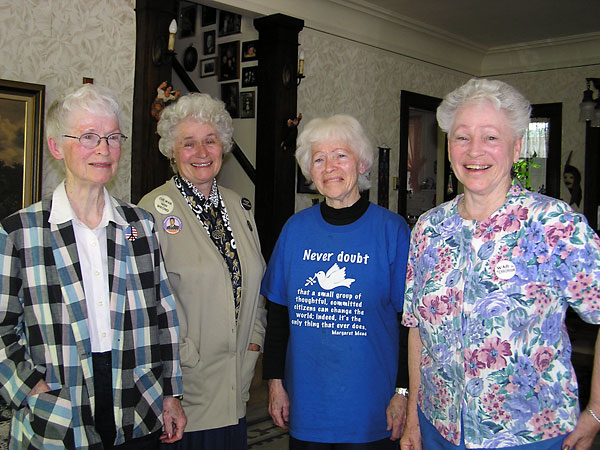 Minnesota Public Radio ran a segment named something that wouldn't normally get my attention: Voices of Minnesota: Religion and Social Justice.
Blah... blah... blah...
But I happened upon it by turning on the radio and hearing a familiar voice talking about women and the church. The McDonald sisters were being interviewed!
Rita, Brigid, Kate and Jane McDonald are four sisters who grew up on a Minnesota farm and all became Catholic nuns. Each have devoted a lifetime to social justice work. And they've all been visible in the anti-war community in Minnesota. It is hard to have attended more than a few anti-war demonstrations in the Twin Cities and not have encountered one or more of the sisters.
As a former Catholic, it was surprising and refreshing to hear a Catholic nun say that she didn't put stock in the notion of original sin and that Jesus' role wasn't to die for our sins. What? I had always been taught in Catholic school that that was a key point.
The McDonald sisters are inspiring whether or not your religious views correspond with theirs. (Mine certainly don't.) Their interview on their faith and work is the first half of the program.
Saturday, March 22, 2008
Editorial on Minnesota AG allegations
The Star Tribune ran an editorial calling for an independent investigation of the allegations involving the Minnesota Attorney General's office. Lori Swanson has been attacked by some current and former staff members who have accused her of ethical wrongdoing and union-busting. The editorial notes that these are only allegations thus far that may, as Swanson suggests, be politically motivated. Nevertheless, they argue and I agree, that because of the power and importance of that office, these serious allegations must be independently investigated. They suggest the Legislative Auditor, who has looked into the Secretary of State's practices around public data, the lawfulness of the governor's JOBZ program, and state lottery agency misappropriation of funds.
I don't know if the Attorney General would accept and cooperate with an outside investigation. I would hope she would. Busy legislators need to first call for such an investigation rather than remain silent. I'm looking forward to hearing a DFL legislator do the right thing and call for an investigation of his or her fellow DFLer, Lori Swanson.
I don't know if the Attorney General would accept and cooperate with an outside investigation. I would hope she would. Busy legislators need to first call for such an investigation rather than remain silent. I'm looking forward to hearing a DFL legislator do the right thing and call for an investigation of his or her fellow DFLer, Lori Swanson.
Tuesday, March 11, 2008
Attorney in AG office put on leave
UPDATE: The Star Tribune is running an Associated-Press piece right now on the lawyer being placed on leave.
Breaking news from the MinnPost.
Eric Black opens:
Lawler was told she was being put on leave because she went to the media about an ethics concern when she should have filed a complaint with the Minnesota Lawyers Professional Responsibility Board instead.
What surprises me after reading Black's original story in the MinnPost last Friday was the lack of further media attention. There seems to be a lot of dysfunction in the office of Attorney General Lori Swanson. As far as I can tell, the Star Tribune and Pioneer Press have yet to cover any aspect of this story. Searching on their websites, none of the local news stations have looked at the matter. Not even Twin Cities Public Television public affairs programs Almanac and Almanac at the Capitol. Only Minnesota Public Radio has given the matter attention, running a piece by Tim Pugmire last week.
Breaking news from the MinnPost.
Eric Black opens:
"Amy Lawler, the assistant attorney general quoted in a MinnPost story Friday about upheaval, fear and retribution in Minnesota Attorney General's Office (AGO), was placed on administrative leave Monday night, in apparent retribution for speaking to MinnPost."
Lawler was told she was being put on leave because she went to the media about an ethics concern when she should have filed a complaint with the Minnesota Lawyers Professional Responsibility Board instead.
What surprises me after reading Black's original story in the MinnPost last Friday was the lack of further media attention. There seems to be a lot of dysfunction in the office of Attorney General Lori Swanson. As far as I can tell, the Star Tribune and Pioneer Press have yet to cover any aspect of this story. Searching on their websites, none of the local news stations have looked at the matter. Not even Twin Cities Public Television public affairs programs Almanac and Almanac at the Capitol. Only Minnesota Public Radio has given the matter attention, running a piece by Tim Pugmire last week.
Friday, March 7, 2008
Drinking teenagers/adults
 Some Minnesota lawmakers have proposed bringing the legal drinking age to 18. To do so would threaten 10% of the federal highway funds to the state and create a political firestorm in a state at the forefront of the prohibition movement a century ago. Some things still haven't changed. Compared to Wisconsin, folks in Minnesota are much more "prudish" when it comes to alcohol, for better or for worse.
This specific proposal would only apply to bars, not liquor stores. The idea is to keep it out in the open and teach healthier drinking habits. Of course, we know that people can still do unsafe drinking in licensed establishments.
Lead sponsor, Rep. Chris DeLaForest, R-Andover, said that since people can serve in the military and get married at 18, they should be able to get a drink or several. "If you're going to give an 18 year old a machine gun, certainly you can trust them to have a cocktail at a bar." (I don't know if beer and guns are necessarily a good combination though.)
I understand the logic of that argument, but it doesn't sound like a winning one. DeLaForest also argues, more persuasively, that we need to teach good drinking habits and points out they drink anyways. "The purpose of the bill is to stop drinking in places like the backseats of cars," DeLaForest said.
Quick aside: It's funny that DeLaForest doesn't take this same view when it comes to sex. He's an abstinence-only guy. Why should I expect consistency from conservative politicians though?
I favor this kind of change. I've long joked that the drinking age should be 16 and driving age at 21. More seriously, there should be more restrictions for teenage drivers. Bumping up the driving age might be a good thing if we were ever able to get decent mass transit in place here. The drinking age at 21 is a fools errand. I hardly drank at all prior to being 21, but I wouldn't describe myself as the norm. At 18, you are legal an adult in just about every other respect. Lots and lots of 18, 19, and 20 year-olds drink alcohol.
The main argument on the other side is that lowering it to 18 makes it easier for even younger people to get alcohol. That is one reason to lower it only for bars and not liquor stores. Allowing young people to drink at 18 might be problematic when it comes to high school senior proms. (You have to imagine a bunch of pre and/or post-prom celebrations will move to the neighborhood bar.) Maybe the starting point shouldn't be during high school. In that case, maybe 19 is a good legal age for bars and lower the age for liquor store purchases to 20.
We need to foster environments that are based in reality and encourage the development of healthy drinking habits. Binge drinking is the way a lot of young people first get introduced to alcohol; and it's behind closed doors. Let's try to introduce drinking to them in the open in bars, where it is less likely to have the dangerous behaviors that all to often end in tragedy.
Wednesday, January 30, 2008
This is just wrong
The below map is courtesy of the Weather Channel. It's as of 11:14 AM local time. Nevermind the vicious windchill factor, which in the middle of the day is still minus 27 F. Makes you want to live in Winnipeg, eh?


Friday, December 28, 2007
Redistricting: A preview
New estimates on population from the U.S. Census give a sense of where we may be after the 2010 Census. One of the most important aspects of the Census every ten years is the congressional reapportionment. Apportionment is the distribution of congressional seats to states based on their population. Each state, regardless of whether they lose, gain, or maintain their seats, must go through redistricting: redrawing the congressional district lines to have equal populations in each district. This will all happen for the 2012 elections.
Generally, it appears congressional seats (and electoral college votes) will shift from the Midwest and rust belt to the West. Southern states like North Carolina, Georgia, and Florida may continue to gain seats too. California, for the first time in its history may not gain a single seat, or even lose a few. The shift to these states also corresponds to growing competitiveness. The next presidential election, and more likely in subsequent elections, will have new swing states in Nevada, New Mexico, Colorado, and maybe even Arizona. Florida will remain competitive and North Carolina and Virginia may be bona fide swing states within the next decade.
Minnesota may very well lose a congressional seat, going from 8 to 7. Because most of the population growth in Minnesota has been in the outer suburbs and exurbs, the district boundaries will most likely shift towards that large donut around the Twin Cities. The Greater Minnesota districts of 1, 7 and 8 will get geographically larger by taking territory out of the current 2nd and 6th (and possibly the 3rd). The urban 4th and 5th districts will have to be collapsed together or expanded outward dramatically.
Option 1 would be to create a single urban district made of Minneapolis and St. Paul and a little slice of suburbs. The 2nd, 3rd, and 6th "inner" boundaries wouldn't shift dramatically in this scenario. Using the district numbers of the current districts (missing the 4th) would look as follows:
The devil is in the details. In Option 1, the 6th could "pack" it's Dem-leaning voters around St. Cloud to the 8th, giving it freedom to give Rep voters to the 2nd to shore it up. In Option 2, if the 4th's new voters come from the Dem areas of the 2nd instead of the 6th, it would allow the 2nd to replace them with Republican voters from the 6th or possibly the 1st.
Politicians always want to hedge their bets. It's possible Republican and DFL legislators could agree on a compromise map that maintains the 4th and 5th districts, and eliminates the now competitive 3rd. This would be largely an incumbent-protection map (except for whoever then serves the 3rd, who would face stiff odds no mater who's district they were now drawn into).
Last time around, the courts decided the Minnesota districts because the Legislature failed to do their job. I am aware of only one state that passed a legislative compromise map. It was Wisconsin, who also lost a seat and ended up drawing an incumbent-protection map.
Generally, it appears congressional seats (and electoral college votes) will shift from the Midwest and rust belt to the West. Southern states like North Carolina, Georgia, and Florida may continue to gain seats too. California, for the first time in its history may not gain a single seat, or even lose a few. The shift to these states also corresponds to growing competitiveness. The next presidential election, and more likely in subsequent elections, will have new swing states in Nevada, New Mexico, Colorado, and maybe even Arizona. Florida will remain competitive and North Carolina and Virginia may be bona fide swing states within the next decade.
Minnesota may very well lose a congressional seat, going from 8 to 7. Because most of the population growth in Minnesota has been in the outer suburbs and exurbs, the district boundaries will most likely shift towards that large donut around the Twin Cities. The Greater Minnesota districts of 1, 7 and 8 will get geographically larger by taking territory out of the current 2nd and 6th (and possibly the 3rd). The urban 4th and 5th districts will have to be collapsed together or expanded outward dramatically.
Option 1 would be to create a single urban district made of Minneapolis and St. Paul and a little slice of suburbs. The 2nd, 3rd, and 6th "inner" boundaries wouldn't shift dramatically in this scenario. Using the district numbers of the current districts (missing the 4th) would look as follows:
- 1st: Taking territory from the 2nd probably won't shift this district very dramatically from a political standpoint. It may become slightly more Republican. It will remain a competitive district.
- 2nd: Losing some Republican voters in the southern, more rural parts of the district will make this Republican-leaning district more competitive.
- 3rd: Losing some western or northern territory to the 6th will mean this Republican-leaning district will become slightly more competitive as well.
- 4th and 5th merged: The single urban district would be overwhelmingly Democrat. A district where the Green candidate would get more than the Republican. Still, highly unlikely for the Greens to make a real run at it.
- 6th: The conservative district may lose some more conservative areas to the 7th and/or 8th districts, replacing some of the voters with slightly less conservative voters in the current 3rd district and a few liberal voters from the current 4th. It will be more competitive as well, but still one that favors a conservative Republican.
- 7th: Will become more conservative and Republican and be a competitive district once the incumbent, conservative Democrat retires.
- 8th: Also will become more conservative and Republican, but will remain a Democratic-leaning district.
- 1st: Same as Option 1. Competitive.
- 2nd: Similar to Option 1. Will offset some voters lost to the 1st with voters in the southern part of the 3rd. Little change.
- 3rd: Eliminated
- 4th: As stated above, would be a majority-suburban district. More conservative depending on whether new voters from the 2nd or 6th. But still a Dem seat.
- 5th: Near parity between urban and suburban voters, but the most Dem seat in the state.
- 6th: Like in Option 1, the conservative district may lose some more conservative areas to the 7th and/or 8th districts, but would also shed more liberal voters to the 4th. New voters from the 3rd lean slightly Republican. The district would remain a Republican-leaning district.
- 7th: Same as Option 1. Competitive, Dem-leaning.
- 8th: Same as Option 1. Dem-leaning.
The devil is in the details. In Option 1, the 6th could "pack" it's Dem-leaning voters around St. Cloud to the 8th, giving it freedom to give Rep voters to the 2nd to shore it up. In Option 2, if the 4th's new voters come from the Dem areas of the 2nd instead of the 6th, it would allow the 2nd to replace them with Republican voters from the 6th or possibly the 1st.
Politicians always want to hedge their bets. It's possible Republican and DFL legislators could agree on a compromise map that maintains the 4th and 5th districts, and eliminates the now competitive 3rd. This would be largely an incumbent-protection map (except for whoever then serves the 3rd, who would face stiff odds no mater who's district they were now drawn into).
Last time around, the courts decided the Minnesota districts because the Legislature failed to do their job. I am aware of only one state that passed a legislative compromise map. It was Wisconsin, who also lost a seat and ended up drawing an incumbent-protection map.
Subscribe to:
Posts (Atom)


